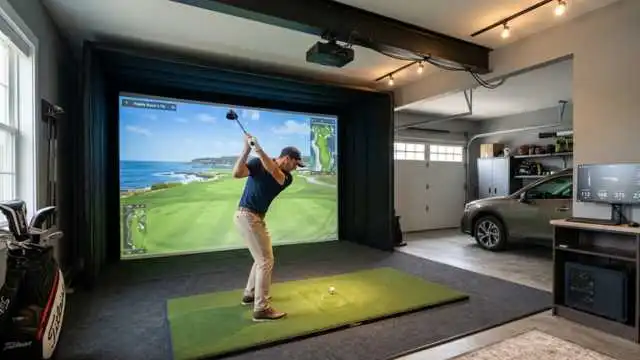
Golf launch monitors have seen a surge in popularity recently, but really, it all boils down to the fact that they eliminate the guesswork from golf practice and equipment testing.
If you are a beginner looking to track progress or an experienced golfer trying to perfect your equipment, learning how do golf launch monitors work will help you make better use of the time you spend practicing and playing simulator rounds.
In this guide, we’ll break down the essential technologies involved, the performance metrics they track, real-world examples of how they’re used, and help you pick a system that fits your specific needs and goals.
Table of Contents
What Is a Golf Launch Monitor?
A golf launch monitor analyzes your shots by recording important club and ball data at the moment of impact and as the ball travels through the air.
Rather than making you guess what you think might have happened, it provides quantifiable performance metrics such as ball speed, launch angle, spin rate, and more — all in real time.
This information is useful for improving your swing, testing equipment, playing on a simulator, and more.
The Core Technology Behind Launch Monitors
Launch monitors collect data in two familiar pathways:
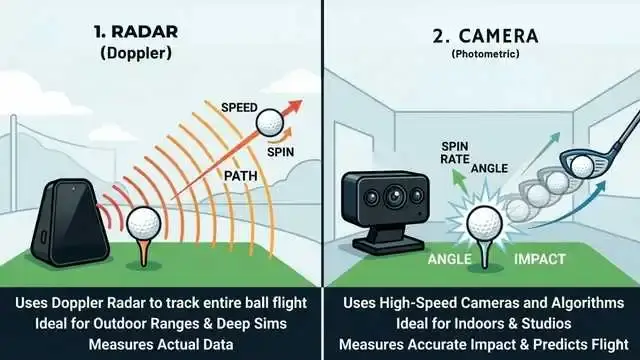
1. Radar (Doppler) Launch Monitors
Doppler radar used by radar systems (such as Trackman and FlightScope models) measures the target motion of a golf ball in-flight after it has been struck. The device sends out microwave signals that reflect off the sliding ball and return information about speed, path, and spin.
How it works:
- Radar sends signals behind the golfer
- Ball sends them back during his travel
- And the following explains how frequency changes are used to work out speed and path
Ideal for:
Outside driving ranges, simulator areas with substantial depth, and players who want actual ball‑flight data — the real thing, not estimates.
Read 10 best outdoor launch monitors for golf practice.
2. Camera (Photometric) Launch Monitors
Camera‑based launch monitors utilize high‑speed cameras placed near the ball that record images just before, as well as during and after impact. Those images track spin, angle, and speed during the first few inches of a ball’s travel before using algorithms to extrapolate the rest of the shot.
How it works:
- Cameras take thousands of frames in 1 second
- The software extracts ball and club information from the images
- Impact data allowing prediction of carry and total flight
Ideal for:
Indoor golfing simulators + club fitting studios | Users needing to measure accurate impact data in constrained spaces
Key Shot Metrics Explained
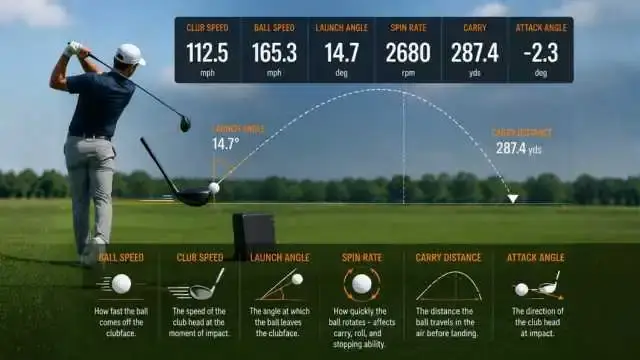
But launch monitors don’t simply give you one number; instead, they offer a multitude of data points that illuminate what is going on with your shot:
Ball Speed
The velocity of the ball as it departs the clubface right after contact.
Discovered club speed
This is your club speed — the velocity of your club head at the point of impact.
Launch Angle
Launch angle refers to the upward angle at which the golf ball takes off from the clubface immediately after impact.
Spin Rate
How quickly the ball rotates impacts carry, roll, and stopping ability.
Carry Distance
The distance a ball travels in the air until it lands
Attack Angle
Are you coming up or down on the ball?
This data can quickly point out why one club goes further than another, and if your swing path is what is causing those slices or hooks.
How Do Golf Launch Monitors Work in Practice?
Here are practical examples every golfer can relate to:
Example 1 — Improving Your Driver Swing
You take ten driver swings on a launch monitor and see strong club speed, but a low launch angle shows you’re leaving potential carry distance on the table. A coach can help tweak your tee height or stance based on this real data rather than feel.
Example 2 — Testing Clubs Before You Buy
Thinking about a new driver? Compare your current driver to the new one with the same swing, ball, and conditions on a launch monitor. You are taught exact differences of spin, launch angle, and carry — not just “feels better.”
Example 3 — Indoor Simulator Practice
A camera-based launch monitor has a simulator bay for playing virtual courses. This system converts your metrics into ball flight, and displays it on the screen during your shot—turning practice into a fun learning experience.
Radar vs. Camera: Which Is Right for You?
| Feature | Radar Launch Monitors | Camera Launch Monitors |
| Best Environment | Outdoor / deep indoor | Small indoor space |
| Captures the complete ball flight from launch to landing | ✔️ | Estimated from the moment of impact |
| Accuracy | High for true ball flight | Excellent for impact data |
| Space Required for Setup | Requires a Wider Setup Area | Fits Easily in Smaller Spaces |
| Lighting Sensitivity | Lower sensitivity | Higher sensitivity |
Both systems are nice — and the one you choose comes down to your building setup and goals.
Common Misunderstandings About Launch Monitors
Here are a couple of places that many golfers get confused about:
1. They Don’t Always Track Every Shot Equally
Basic metrics and estimates, especially with respect to club data, may only be collected by lower‑end monitors. Because more measurement points are combined, higher‑end models are more reliable.
2. Simulator Setup Matters
Indoor precision varies with room depth, lighting conditions, and ball visibility. A radar monitor has limitations in being able to determine what it sees for tracking accurately inside a small room.
3. Data Doesn’t Improve Your Game — You Do
While numbers are a powerful currency, you will need a plan. They are not magical solutions, but they can serve as tools that guide practice.
FAQ: Golf Launch Monitors
Yes, although some high-end systems work best with premium balls, radar relies on consistent reflections to get the most accurate readings.
Of course, but you will want to ensure that your space is sufficiently large and well-lit, especially for a camera‑based system.
Radar keeps track of the ball during its flight, camera systems focus on impact, and software predicts the rest.
Yes — They transform subjective sensations into indisputable data — such that you know exactly what’s working and what needs fixing.
For serious or avid golfers, when you set goals and use the data to inform your practice, it can be transformative.
Conclusion
By learning “how do golf launch monitors work”, you can elevate your game more quickly with better club and ball choices, leading to better practice sessions.
Whether you are training with a radar system outdoors or enjoy the ideal conditions of simulator sessions indoors, modern launch monitors put important shot information in your hands – so train smart, not hard.